Double Lives and Secret Identities in Marriage
Mr. & Mrs. SmithDouble Lives and Secret Identities in Marriage describes a household organized around performance: Jane Smith and John Smith appear to inhabit a carefully maintained suburban ideal, yet each keeps a dangerous professional identity from the other. The contrast is not simply between domesticity and covert work. Their home life is itself labor, staged with the same ambition as their secret occupations, while the objects and rituals of the household become both cover and evidence of the emotional distance the performance cannot repair.
The Ideal Home as a Performance
Jane recognizes that her ideal life is not ideal, but responds by working harder to make it look and feel that way. She applies to the house, garden, and food the ambition and diligence she brings to work. Dinner is a striking measure of this effort: she can cook as if preparing a banquet for fifty, yet does it every evening for two. The scale of her labor exceeds the apparent needs of the household, making domestic perfection less a settled reality than a project she continually tries to complete.
That project makes small disagreements carry disproportionate weight. In a recorded account of the marriage, Jane says John can be physically present in a room and still seem absent. The recording stops before she can elaborate, but the remembered examples are ordinary: an argument about curtains, a lack of conversation at dinner, and a quarrel over passing the salt or which side of the table it belongs on. Such matters are not important in themselves, the account observes, yet their recurrence gives them importance as the places where a larger disconnection becomes visible.
The décor dispute shows how a minor choice can expand into an entire chain of domestic work. Jane displays new green curtains for a living room that is already fully furnished. Their striking color prompts her to consider a checked sofa cover, which in turn would require a darker rug. John follows the logic to its comic conclusion: they would be buying further furnishings to accommodate curtains they did not need, and suggests keeping the old curtains. His practical objection does not resolve the difference between them; it exposes how each household decision can become a contest over whose preference sets the terms.
Their domestic disagreements also appear as failed attempts at care. John brings home salted butter when Jane had asked for unsalted. He inwardly experiences her requests as impossible assignments, like a task set by an ice princess that he cannot successfully complete; Jane brushes off his apology and says she will make do. The mismatch is slight in material terms, but it joins the other recurring complaints in showing how a routine exchange can acquire the emotional charge of a test neither spouse knows how to pass.
Rituals and the Silence Between Them
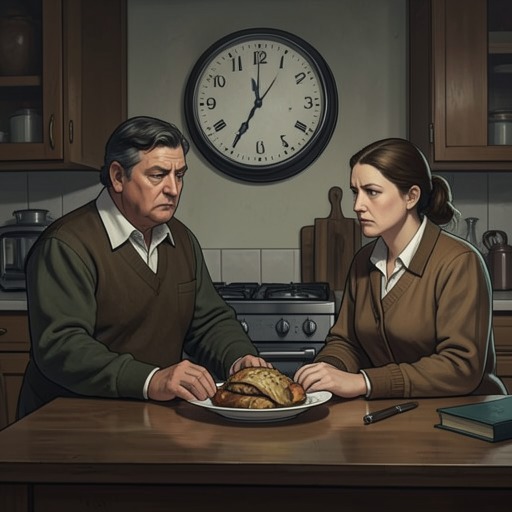
At dinner, John gives up trying to explain himself and eats without further comment before asking Jane to pass the salt. Even that request becomes a struggle over who will win. The salt is thus both an everyday object and a recurring point at which the couple’s habitual antagonism takes shape: a simple act of cooperation is turned into a contest, while the conversation that might explain the resentment never arrives.
The pattern continues after dinner. Washing dishes is a daily ritual, performed in silence: John rinses the plates under running water and Jane puts them in the dishwasher, as they always do. Their coordinated task demonstrates that they can share a routine, but its regularity does not amount to intimacy. In another account, Jane imagines that they might go to bed at the same time and really talk, then notes that they never do. Their schedules instead separate them: John may stay in his office or hobby room, or work in the shed, while Jane remains awake for kitchen chores, watches an old black-and-white film, or falls asleep on the sofa. John usually leaves her there and says the next morning that he did not want to wake her.
The domestic silences matter because they are not a lack of activity. Jane fills the home with cooking, furnishing, and household tasks; John keeps busy in private rooms and the shed. The couple can maintain a house and complete its routines while avoiding the conversation that might make their shared life emotionally legible. Their marriage’s distance is therefore expressed through repeated, concrete practices rather than a single dramatic rupture.
Secret Work Behind Ordinary Appearances
The division between public home life and secret work is built into each spouse’s habits. Jane undertakes nighttime assignments and wonders what John would think if he knew how she escaped their stifling life in the middle of the night. Her question turns secrecy into more than concealment of a job: the work offers an exit from the life she experiences as constricting, while the possibility that John might not care deepens the uncertainty between them.
Her professional identity can surface almost literally beneath her housewife appearance. Returning from work at about nine, Jane has no time to shower and change, so she puts on a loose pink dress from her housewife collection over a black dominatrix outfit. As she fastens the dress, her internal alarm alerts her to John leaning against the doorway and studying her. The scene makes the domestic disguise visible as clothing layered over another role, while John’s unexpected presence threatens to expose what the costume is meant to cover.
John’s parallel secrecy is embedded in the landscape of the home. At sunrise, carrying a briefcase, he crosses the back lawn whistling like a happy husband going to work. Once inside the shed, he stops whistling and closes the door. The shed appears to contain tools, but it conceals the equipment of his real profession: he moves the workbench, opens a floor safe, works the combination lock, and releases a trapdoor. The transition from cheerful performance to hidden armory is exact and deliberate; the ordinary yard and shed provide the setting in which the false account of an ordinary working day can be maintained.
Jane uses domestic competence in a similar way. Because John cannot even boil water, she realizes that the kitchen is an especially good place to hide secrets. She enters a code, and the bottom of the oven slides open to reveal her carefully maintained collection of sleek weapons and gleaming knives, clean, oiled, and arranged. She selects a favorite knife and slides it along her thigh. The kitchen’s visible function—food preparation—therefore coexists with a concealed arsenal, while Jane’s expertise at managing the household gives her control over a space that can serve her covert work as well.
The organizations behind these separate lives remain present even in the quietest hours. At three in the morning, Jane’s superior, code-named Vader, calls with an urgent assignment. His instructions are brief and direct, without personal questions or the ordinary courtesy of asking whether he has woken her. The call makes the contrast between professional and marital communication especially sharp: her employer supplies orders without intimacy, while the spouse beside her remains outside the truth of her work.
When the Two Lives Collide
The couple’s secret identities are not merely private information; each person’s movements can bring the other close to discovery. Jane reaches suite 5204E at 550 Lexington Avenue and reads the company name, Triple Click, beside it. Recognition hits her like the desert explosion that had previously knocked her down. The ordinary corporate façade—an IT staffing agency—becomes the point at which a covert mission intersects with the life she shares with John, threatening the separation on which their concealment depends.
At home, the tension between the couple’s roles also turns their domestic scenes into precarious comedy. A small grenade drops from a ventilation opening and rolls across the floor. It resembles a toy bundled with a Happy Meal, a Barbie grenade, but Jane knows it is real; she is only milliseconds from death when John calls out that she is dead. The toy-like appearance of the weapon collides with the lethal situation, just as the couple’s home life repeatedly sets familiar household surfaces against the dangers their professional identities bring into them.
The collision finally becomes physical destruction. During the gunfight, John fires as he heads for the dining room, shattering attractive glasses and striking Jane’s cherished teapot and its matching kettle. Jane pauses in disbelief at the ruin of her favorite room: appliances, cupboards, and decorations are destroyed, and nothing of the kitchen remains. The scene gives the hidden conflict a domestic cost. The kitchen that once joined food, household labor, and concealed weapons is no longer a protected compartment; the violence of their professional lives has broken into and obliterated the space Jane had made her own.
Even their escape from danger carries the marks of the ordinary world that has become unsafe. In a home-goods store, Jane and John sense agents entering; John’s hand on her elbow signals her to go, and they jump from a swing as the lights go out. Moving past a box filled with teddy bears, they encounter Homey, the store’s life-sized mascot, wearing a house-shaped hat and moustache and carrying a sawed-off shotgun. Without blinking, they each shoot the oversized stuffed head; as Homey falls backward, the weapon fires into the ceiling. What should have been a skirmish with an undercover agent becomes a major public incident. The incongruity of toys, home merchandise, and gunfire extends the book’s central collision beyond their own house: even spaces built to sell the comforts of home can become stages for the secret lives that their marriage has kept hidden.
The Meaning of the Double Life
The double life in the marriage operates through more than false names or concealed weapons. Jane’s elaborate dinners for two, John’s performance of the cheerful husband walking to work, and the silent division of labor at the sink all show how everyday life can be meticulously enacted without becoming honest or shared. Domestic rituals resemble professional routines in their planning and repetition, but the marriage lacks the openness that might give those routines mutual meaning.
The book repeatedly lets comedy and danger occupy the same object or gesture. Salt can become a contest; curtains can set off a cascade of imagined purchases; a grenade can look like a fast-food toy; an oven can conceal knives; a housewares mascot can carry a shotgun. These reversals make the suburban setting both convincing cover and unstable refuge. What appears harmless may conceal a weapon, while what seems trivial may reveal the marriage’s deepest trouble.
Ultimately, the spouses’ professional secrecy and emotional estrangement reinforce one another without being identical. Their covert occupations require concealment, but the repeated failures of ordinary conversation show that the marriage has its own silences, enacted at dinner, at bedtime, and over household work. When violence destroys the kitchen and forces the couple into public flight, the hidden and visible lives can no longer be kept apart. The double identity that once allowed each spouse to perform an ordinary household role becomes the condition through which their shared danger is exposed.